The Vacuum
There is a concept in quantum physics that directly aligns with the ancient philosophical concept of Horror Vacui, which states, "Nature abhors a vacuum." In classical physics, a vacuum is defined as a completely empty space. However, quantum mechanics states that a true, completely empty "nothingness" cannot exist.
The energy level of any given point in space cannot remain precisely at absolute zero. If it were exactly zero, its energy value would be completely certain, which violates quantum law. As a result, the lowest possible energy state of space, known as the quantum vacuum state or ground state, still possesses a residual, baseline energy called Zero-Point Energy. In everyday operation, quantum fields satisfy the rule that "nature dislikes a vacuum" by constantly generating pairs of virtual particles (such as an electron and its antimatter twin, a positron). These particles spontaneously pop into existence out of the vacuum, interact briefly, and then annihilate each other back into nothingness. A vacuum creates uncertainty, and the Big Bang itself happened due to this uncertainty.
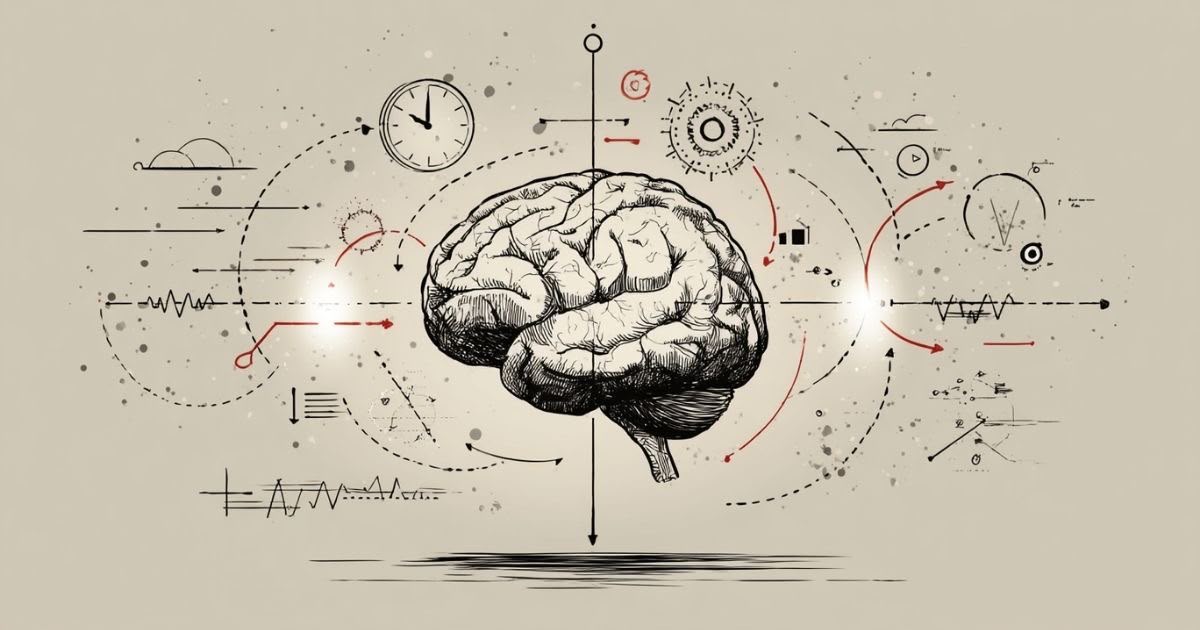
Our everyday lives and, most importantly, the human brain itself operate in the same way. The brain is a prediction engine that abhors a psychological vacuum. If there is a lack of external push, such as a structured task or clear direction, it automatically generates its own internal data to fill the void. In a famous 2014 study, researchers left participants alone in an empty room for 15 minutes without any distractions except for a button that would give them an electric shock. 67% of men and 25% of women chose to receive the electric shock rather than sit with their own empty minds. The brain preferred physical pain over the agonizing "nothingness" of a cognitive vacuum.
Evolution has set up our brain in such a way that when there is absolute silence, we consider it a sign of danger. To our ancestors, an unknown, empty silence in the brush didn't mean safety; it meant a hidden predator. When the brain receives zero incoming data from the environment, it fills the gap by simulating the worst-case scenario to keep you prepared. Anxiety is just the brain's way of saying, "I have no information right now, so I will invent a problem to make sure we stay alert."
Since we cannot stop the brain from filling an empty space, the trick is to intentionally choose the filler before the brain chooses it for you.
Just as physicists use external fields to manipulate quantum states, we can manage the brain's vacuum. Since we cannot stop the brain from filling an empty space, the trick is to intentionally choose the filler before the brain chooses it for you. This is why structured routines, mindfulness (forcing focus onto a single point like the breath), and engaging hobbies are so effective, as they occupy the "space" so anxiety cannot spawn there.